
Understanding the ACA Family Glitch and How Families Can Qualify for Tax Subsidies
The Affordable Care Act (ACA) was designed to make health insurance more accessible and affordable for millions of Americans. However, for years, a technical flaw known as the “family glitch” prevented many families from qualifying for premium tax credits—even when employer-sponsored coverage was unaffordable for dependents. Recent policy changes have corrected this issue, opening the door for thousands of households to receive financial assistance through the Health Insurance Marketplace.
What Is the ACA Family Glitch?
The family glitch occurred because of how the ACA defined “affordable” employer coverage. Under the original rule, affordability was based only on the cost of coverage for the employee, not the cost of adding family members.
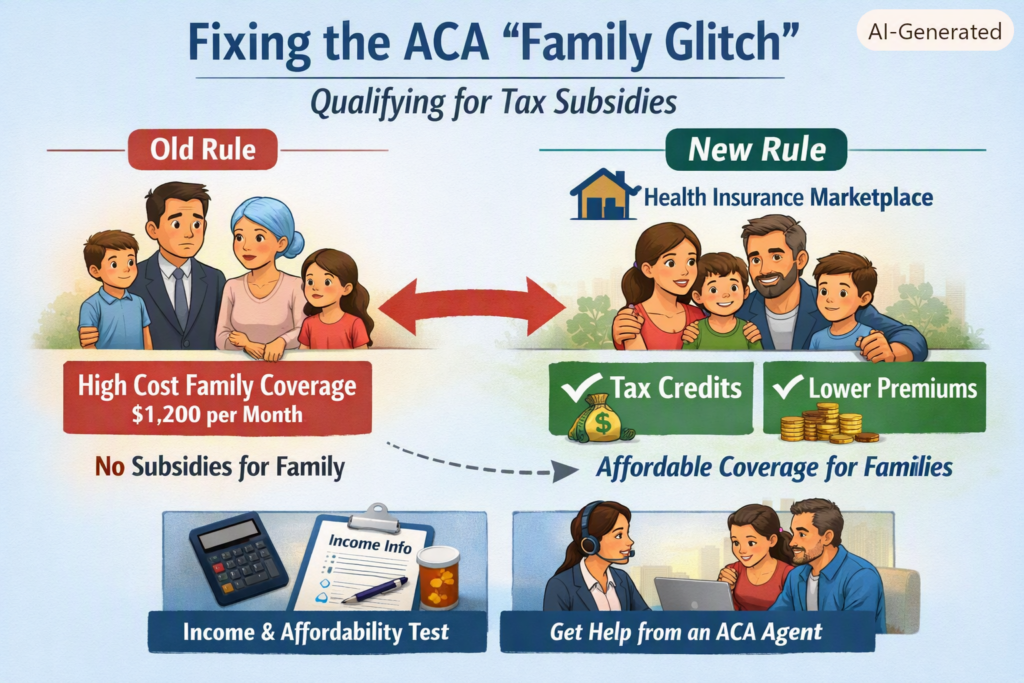
For example, if an employer offered a plan that cost $150 per month for the employee but $1,200 per month for family coverage, the plan was still considered “affordable” under the ACA. As a result, the employee’s spouse and children were ineligible for premium tax credits on the Marketplace—even though family coverage was financially out of reach.
This created a gap where families were stuck between two unaffordable options:
- Paying high premiums for employer family coverage
- Paying full price for Marketplace coverage without subsidies
How the Family Glitch Was Fixed
The family glitch occurred because of how the ACA defined “affordable” employer coverage. Under the original rule, affordability was based only on the cost of coverage for the employee, not the cost of adding family members.
For example, if an employer offered a plan that cost $150 per month for the employee but $1,200 per month for family coverage, the plan was still considered “affordable” under the ACA. As a result, the employee’s spouse and children were ineligible for premium tax credits on the Marketplace—even though family coverage was financially out of reach.
This created a gap where families were stuck between two unaffordable options:
- Paying high premiums for employer family coverage
- Paying full price for Marketplace coverage without subsidies
How the Family Glitch Was Fixed
In 2022, the U.S. Treasury and IRS finalized a rule to correct this problem. Starting with the 2023 plan year, affordability is now determined separately for the employee and their family members.
Here’s how it works:
- If the employee-only coverage is affordable, the employee cannot receive subsidies.
- If the family coverage is not affordable, dependents may qualify for premium tax credits on the Marketplace—even if the employee remains on the employer plan.
This change ensures that families are no longer penalized when employer-sponsored family coverage costs too much.
How Families Can Qualify for Tax Subsidies
Premium tax credits are designed to lower monthly premiums for Marketplace plans. To qualify, families must meet certain criteria:
1. Income Requirements
Household income must fall between 100% and 400% of the federal poverty level (FPL)—though some states extend subsidies beyond that range. For 2026, this generally means:
- About $14,000–$58,000 for an individual
- About $29,000–$120,000 for a family of four
2. Employer Coverage Affordability Test
The cost of employer-sponsored family coverage must exceed 9.12% of household income (the affordability threshold for 2026). If it does, dependents may qualify for Marketplace subsidies.
3. No Other Minimum Essential Coverage
Family members cannot be eligible for other minimum essential coverage, such as Medicaid, CHIP, or Medicare.
4. Marketplace Enrollment
Eligible family members must enroll in a Marketplace plan to receive subsidies. The employee can stay on the employer plan or join the Marketplace separately.
How Premium Tax Credits Work
Premium tax credits reduce the monthly cost of Marketplace plans based on income and household size. The lower your income, the higher your subsidy. Families can choose to:
- Apply credits in advance to lower monthly premiums, or
- Claim them at tax time when filing their federal return
For example, a family earning $60,000 might qualify for a subsidy that reduces their monthly premium from $1,200 to $400—saving $800 per month.